


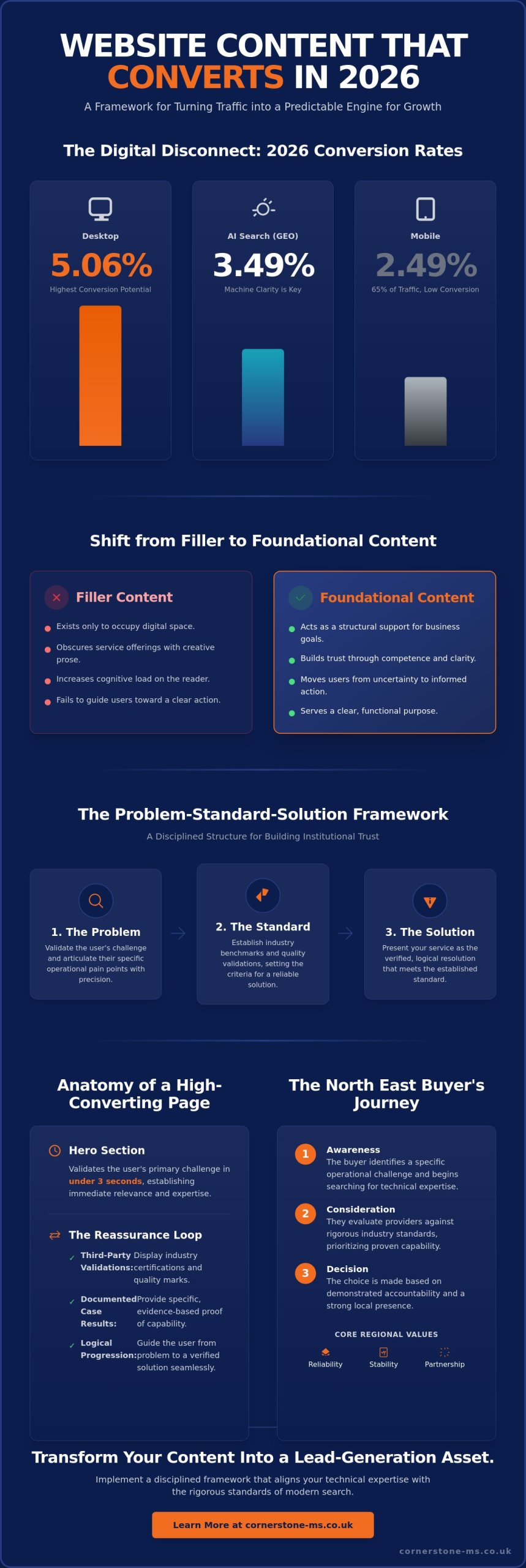
While mobile devices account for approximately 65% of global web traffic in 2026, their average conversion rate remains a modest 2.49 percent compared to the 5.06 percent achieved on desktops. This performance gap often stems from a fundamental disconnect between technical infrastructure and user intent. You likely recognize the frustration of seeing healthy traffic numbers that fail to translate into consistent leads; it makes your digital presence feel more like a static brochure than a functional asset. Mastering how to write website content that converts is not about using flashy sales language. Instead, it is about building a foundation of institutional trust and operational clarity that guides a visitor toward a purposeful decision.
We believe that high-quality content should serve as the essential foundation for your client operations. This guide provides a disciplined framework to refine your service pages and align your messaging with the rigorous standards of modern search algorithms. You will learn how to balance technical precision with human-centric storytelling to ensure every visitor finds a reliable path to a verified solution. By the end of this article, you will have the strategic tools to improve your brand authority and turn existing traffic into a steady, predictable engine for growth.
Key Takeaways
- Distinguish between generic filler copy and foundational content that facilitates a clear psychological transition for your visitors.
- Master the Problem-Standard-Solution framework to learn how to write website content that converts by prioritizing utility and structural stability.
- Map the North East buyer’s journey to align your messaging with regional values of reliability and long-term institutional partnership.
- Utilize semantic search and local SEO strategies to ensure your technical expertise is visible to stakeholders in Stockton and Middlesbrough.
- Implement a durable pillar-and-support model to maintain brand authority and ensure your content remains a reliable lead-generation asset.
Beyond the Buzzwords: Defining Website Content That Converts in 2026
In 2026, the definition of effective copy has evolved beyond simple persuasion. We define conversion-focused content as copy that moves a user through a specific psychological transition from a state of uncertainty to a state of informed action. This requires a shift from filler content, which exists only to occupy digital space, to foundational content. Foundational content acts as a structural support for your business objectives, ensuring every word serves a functional purpose. Learning how to write website content that converts is now a matter of technical precision rather than just creative flair.
Modern search requirements demand that content satisfy both human intent and Generative Engine Optimization (GEO). As AI search platforms like ChatGPT and Perplexity drive higher conversion rates, averaging 3.49% according to 2026 data, your copy must be structured for machine clarity while remaining deeply resonant for the end-user. We achieve this through structural stability in copy. This means building trust through displayed competence and logical progression rather than flashy adjectives. A foundational Content marketing overview shows how the industry has shifted, but in 2026, the application must be more precise to maintain a competitive edge. By focusing on intent, we ensure the content remains an essential foundation for client operations.
The Anatomy of a High-Converting Page
A high-converting page begins with a Hero Section that validates the user’s challenge in under three seconds. This is where we establish immediate relevance. In a B2B context, technical precision always outperforms marketing fluff. We prioritize evidence-based claims that demonstrate a thorough understanding of regulatory adherence and operational requirements. To solidify trust, we integrate a reassurance loop containing:
- Third-party quality validations and industry certifications.
- Specific, documented case results that highlight capability.
- A logical progression that guides the reader from a problem to a verified solution.
Why “Good Writing” Isn’t Always “Converting Writing”
Many businesses fall into the trap of creative prose that inadvertently obscures their actual service offering. While good writing might be aesthetically pleasing, it often fails to drive action if it increases the cognitive load on the reader. We use direct and functional language to highlight capability and action. This clarity ensures that the core message of efficiency is never obscured by unnecessary complexity. Knowing how to write website content that converts involves stripping away the unnecessary to reveal the solution. We prioritize the end-user experience to ensure the narrative guides them toward a reliable outcome. Conversion-focused content is the bridge between curiosity and commitment.
Audience Architecture: Mapping the North East Buyer’s Journey
The North East business landscape operates on a foundation of mutual respect and long-term stability. Stakeholders in areas like Teesside and Stockton-on-Tees don’t just look for a service provider; they look for a dependable partner. Understanding this regional nuance is the first step in learning how to write website content that converts for a local audience. While generic guides focus on broad demographics, we recognize that our community values quiet confidence and proven capability over flashy, high-pressure sales tactics. Your content must reflect a disciplined expertise that aligns with the grounded, human-centric approach of the region.
The buyer’s journey follows a methodical progression. It begins with Awareness, where the reader identifies a specific operational challenge. This moves into Consideration, where they evaluate whether a provider meets rigorous industry standards. Finally, they reach the Decision stage, choosing the entity that demonstrates the highest level of accountability and local presence. Generic, AI-generated content often fails this process because it feels foreign to local stakeholders. It lacks the technical precision and regional context that act as essential trust anchors. Without these anchors, a website remains a digital brochure rather than a functional lead-generation engine.
Identifying Local Pain Points and Priorities
We move beyond simply stating what we do to explaining how we solve the North East’s specific challenges. Building proximity requires more than just keywords; it involves referencing local landmarks and regional case studies that prove a visible pride in workmanship. This grounded approach is a core part of our Web Design North East: Building a Digital Foundation for 2026 strategy. By prioritizing structural stability for our clients’ digital platforms, we ensure their message resonates with the local workforce and leadership alike.
The Reassurance Factor: Building Institutional Trust
We use active voice to demonstrate accountability in every service delivery. By framing regulatory adherence as a competitive advantage, we reassure clients that their operations are secure and efficient. The Cornerstone Group legacy serves as a marker of stability in a demanding industry, suggesting a brand that values long-term collaboration over short-term gains. We focus on the end-user experience to improve quality of life, positioning our services as an essential foundation for your business. If you are looking to strengthen your digital presence, our SEO (Search Engine Optimisation) strategies can help align your technical standards with user expectations.
The Psychology of Copywriting: Crafting Headlines and Narrative Flow
A reliable website acts as the essential foundation for your client operations. To ensure this foundation is secure, we apply a methodical rhythm to our prose. When considering how to write website content that converts, we must look beyond mere persuasion and focus on the psychological progression of the reader. We utilize the Problem-Standard-Solution framework to structure our narrative. This involves identifying a specific operational challenge, explaining the rigorous standards required to address it, and concluding with a verified solution. This logical flow creates a steady sense of security that guides the reader toward a purposeful decision.
Visual tracking studies often highlight the F-Pattern of reading, where users focus heavily on the top and left side of the page. Because of this, the first two paragraphs of every section are critical for establishing competence. We also pay close attention to micro-copy, such as button text, captions, and form headers. These small segments of text reduce friction at the point of enquiry by providing clear, functional instructions. By maintaining technical precision in every element, we ensure the core message of efficiency is never obscured. This disciplined approach transforms a digital presence into a dependable lead-generation engine.
Headlines That Signal Competence
We move away from clickbait and focus on headlines that state a specific benefit with quiet confidence. Every heading must pass the “So What?” test, ensuring it communicates utility and stability to the reader. Headlines are the structural beams of your content’s architecture. They should promise a reliable outcome rather than just seeking attention. By prioritizing clarity, we reduce the cognitive load on the reader and build long-term institutional trust through a display of expertise.
The Flow of Persuasion: From Problem to Verified Solution
Validating an operational challenge before presenting a technical fix is vital for building a grounded, human-centric connection. We often employ metaphors related to structural stability and foundational support to reinforce our brand identity. This narrative technique helps present complex concepts in clear, logical segments. For businesses looking to establish this level of authority, our Branding Agency Newcastle: The Strategic Guide for North East Businesses in 2026 provides a comprehensive roadmap. We believe that understanding how to write website content that converts requires a commitment to societal impact and a pride in workmanship that resonates with stakeholders across the region.
Balancing Search Engines and Human Readers: SEO for Conversion
We believe that technical precision and human-centric messaging are not mutually exclusive. In 2026, understanding how to write website content that converts requires a sophisticated approach to semantic search. Rather than forcing keywords into the narrative, we focus on topical depth and user intent. This ensures that the core message remains accessible while signaling relevance to search algorithms. For firms in Stockton and Middlesbrough, local SEO is the cornerstone of this strategy. By integrating regional signals, you establish your business as a reliable, local presence that stakeholders can trust.
Search engines now prioritize E-E-A-T (Experience, Expertise, Authoritativeness, and Trustworthiness) more than ever. Generic content loses impact because it lacks the human element of real-world experience. We demonstrate accountability by presenting operational requirements in clear, logical segments. Technical SEO also plays a vital role in how users perceive your reliability. A site that loads slowly or fails on mobile devices suggests a lack of attention to detail. With mobile accounting for 65 percent of traffic but only converting at 2.49 percent, optimizing for the mobile experience is an essential foundation for improving your results. Desktop conversion rates of 5.06 percent highlight the need for a seamless, cross-device strategy that maintains structural stability.
The GEO Shift: Writing for AI Answer Engines
Generative Engine Optimization (GEO) is a critical component of a modern content strategy. AI search platforms now drive traffic that converts at an average rate of 3.49 percent, which is 22 percent higher than traditional organic search. To capture this, we structure our claims with clear evidence and logical progression. FAQ sections are particularly valuable for addressing long-tail “how to” queries that AI engines prioritize. Our Local SEO Services: Driving Growth for North East Businesses in 2026 framework ensures your business is positioned as the verified solution in these conversational searches.
Trust Signals: Beyond the Text
Words alone cannot always convey the full scope of your operational security. We use professional videography and drone videography to validate the claims made in your copy. These visual assets provide a shorthand for excellence through a display of actual workmanship and scale. High-quality UI/UX design further enhances the “conversion-readiness” of your site. It creates a rhythmic sense of security that guides the reader from a problem to a verified solution. A professional website design is the essential foundation for any content strategy. If you’re ready to align your technical standards with high-conversion copy, explore our SEO (Search Engine Optimisation) solutions today.
Building Your Content Pillar: Implementation and Maintenance
A comprehensive digital presence requires more than isolated blog posts; it demands the structural stability of a Pillar and Support model. We view your core service pages as the primary pillars of your authority. These pages must be supported by a network of relevant, high-quality sub-topics that reinforce your expertise. When you focus on how to write website content that converts, you aren’t just looking for a single viral moment. You are building a hub of long-term institutional trust. This methodical approach ensures that your website remains a reliable lead-generation engine rather than a forgotten digital asset.
Maintaining this engine requires a recurring audit and update programme. Search engine algorithms and user behaviors evolve constantly. In 2026, the global average website conversion rate sits at 2.35 percent, but top performers achieve rates five times higher through disciplined refinement. We measure what matters by shifting the focus from vanity metrics like “hits” to qualified lead enquiries. This data-driven perspective allows us to identify where the narrative flow is strong and where it requires technical precision to reduce friction. We prioritize accountability in every update to ensure your content remains a verified solution for your audience.
Creating a Content Roadmap
Developing a 12-month strategy is essential for building a reputation of unwavering reliability. We identify your core service pillars and map out the supporting content needed to establish authority. This roadmap includes regional insights, such as our Social Media Management Teesside: The 2026 Business Growth Guide. By aligning your content with local priorities and technical standards, we ensure your brand becomes an essential foundation for community growth and long-term partnership.
The Cornerstone Advantage: Professional Execution
Professional content creation outlasts DIY or pure AI efforts because it incorporates human judgment and technical expertise. We use real-world experience and third-party validations to create a narrative that resonates with stakeholders. Our team values long-term collaboration, providing the steady, rhythmic sense of security your business needs to thrive in a demanding industry. We invite you to contact Cornerstone for a comprehensive digital audit to begin your journey toward high-conversion copywriting and sustainable digital growth.
Strengthening Your Digital Infrastructure for 2026
Transitioning from a digital brochure to a lead-generation engine requires a commitment to technical precision and regional relevance. We have explored the importance of mapping the buyer’s journey through a framework of structural stability. By prioritizing clarity over creative prose, you ensure your message remains an essential foundation for your operations. Mastering how to write website content that converts is a continuous process of auditing and refining your narrative to meet the rigorous standards of modern search engines and human readers alike.
Our dedicated North East support team applies the award-winning Cornerstone Group legacy to every project. We combine high-level expertise in Web Design and SEO to deliver measurable results through technical precision. You don’t have to navigate these operational requirements alone. Build your digital foundation with Cornerstone’s content specialists today to secure your place as a reliable leader in your industry. Your website has the potential to become your most dependable partner in growth.
Frequently Asked Questions
How long should website content be to convert?
Content length should be determined by the complexity of your service and the depth of user intent. Most service pages require between 500 and 1,000 words to establish technical authority and provide a verified solution to operational challenges. We focus on utility and structural stability rather than arbitrary word counts. This ensures your message remains a reliable foundation for client decision-making without becoming obscured by unnecessary filler.
Does SEO content still work for local businesses in the North East?
Localized search strategies remain the most effective way to build institutional trust within Stockton, Middlesbrough, and the wider Teesside area. Search engines continue to prioritize regional signals that demonstrate a visible pride in local workmanship. By addressing the specific priorities of North East stakeholders, you position your business as a dependable partner. This regional focus acts as a trust anchor that generic national copy cannot replicate.
What is the best call-to-action for a service page?
The most effective call-to-action is direct and functional, clearly stating the next step in the professional relationship. Use declarative prompts like “Enquire About Service Standards” or “Request a Technical Audit” to reduce friction at the point of enquiry. We recommend placing these prompts after you have validated an operational challenge and presented a clear solution. This methodical rhythm guides the reader toward a purposeful commitment.
How often should I update my website content?
We recommend a recurring maintenance programme every six to twelve months to ensure your technical claims and regulatory adherence remain current. Regular updates signal to search engines that your entity is a disciplined, active participant in your industry. Consistent refinement is a fundamental part of learning how to write website content that converts. It allows you to adapt to evolving user behaviors and maintain your brand’s authority.
Can I use AI to write my conversion-focused content?
AI tools can assist with initial research and structural outlining, but they often lack the technical precision and human-centric approach required for high-stakes industries. AI-generated text frequently fails to capture the quiet confidence and regional nuances valued by North East businesses. We believe that professional execution requires human judgment to ensure the narrative remains grounded and authentic. Using a disciplined expert to refine your copy builds long-term institutional trust.
What is the difference between copywriting and content writing?
Copywriting is the strategic application of language to move a user through a psychological transition toward a specific action. Content writing provides the essential foundation of expertise and information that builds brand authority over time. Both disciplines are vital when considering how to write website content that converts. While content writing establishes the standard of service, copywriting acts as the bridge that turns curiosity into a verified commitment.
How do I track if my content is actually converting?
We prioritize measuring qualified lead enquiries and purposeful user interactions over vanity metrics like total page hits. Use advanced analytics to track form submissions, button clicks on service pages, and the logical progression of visitors through your content pillars. This data-driven approach allows you to identify which sections of your narrative are successfully building trust. Constant monitoring ensures your digital presence remains a functional and efficient asset for your operations.