


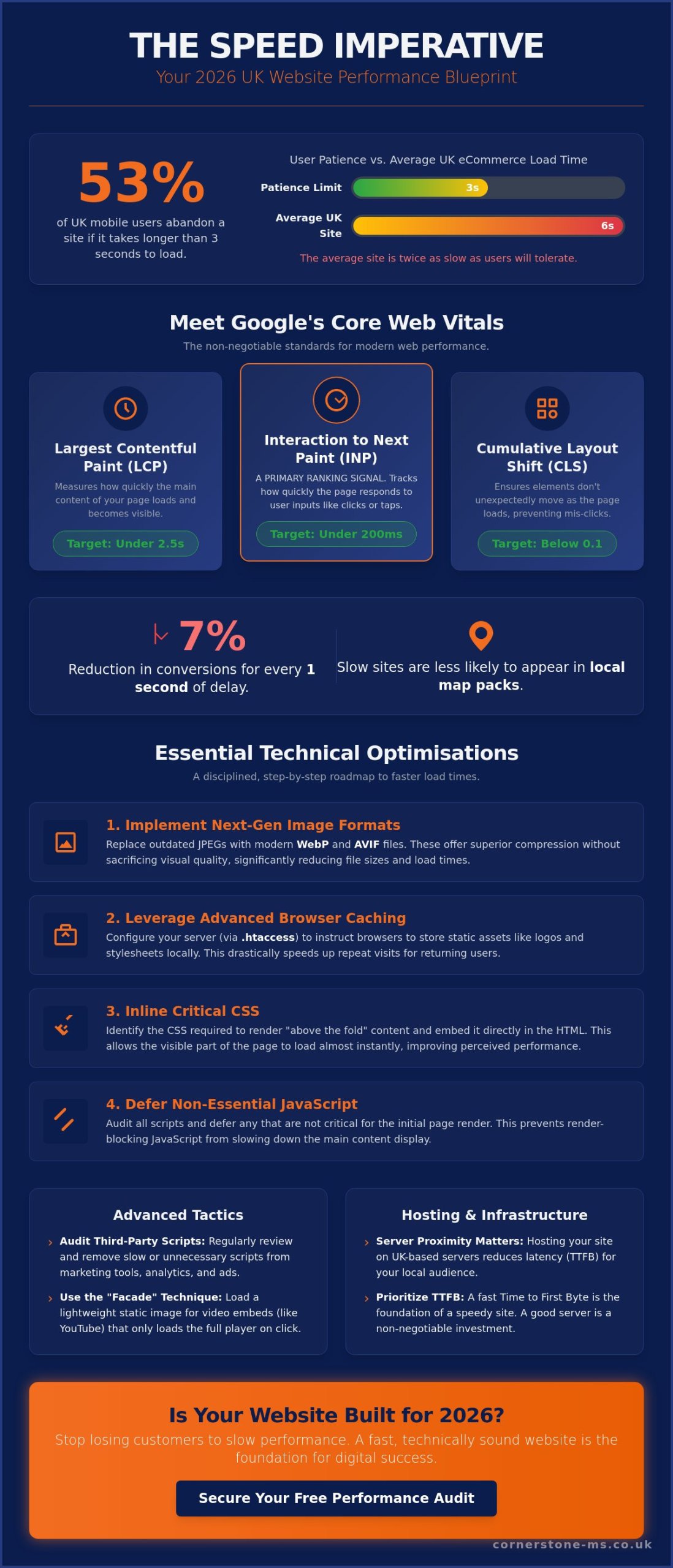
Did you know that 53% of mobile users in the UK will abandon a website if it takes longer than three seconds to load? Even with the expansion of 5G networks, the average UK eCommerce site still lingers at a six-second load time, which is double the threshold of user patience. If you’re asking how to make my website faster uk, you’ve likely noticed that slow performance is costing you visibility and conversions. It’s frustrating to lose ground to competitors simply because of technical bottlenecks or confusing jargon that makes optimization feel out of reach.
We believe that a fast, accessible website is the essential foundation for your digital success. This guide provides a disciplined, technical roadmap to help you pass Core Web Vitals and meet the latest Interaction to Next Paint (INP) standards. We’ll show you how to utilize PHP 8.5 and WordPress 7.0 to achieve a Largest Contentful Paint (LCP) under 2.5 seconds. By following these precise adjustments, you’ll create a seamless experience for your local customers and secure the improved Google rankings your business deserves.
Key Takeaways
- Identify the shift in 2026 performance standards toward visual stability and user interactivity to ensure your site meets modern expectations.
- Master the technical steps for how to make my website faster uk through the implementation of next-generation image formats and advanced server-side caching.
- Evaluate the impact of physical server proximity and Time to First Byte (TTFB) on your local search visibility and user retention rates.
- Learn to streamline your site by auditing third-party scripts and deploying the “Facade” technique for media embeds to prevent performance lag.
- Understand why a disciplined focus on speed and technical SEO is the non-negotiable foundation for any successful web design project.
Understanding Website Speed Standards for UK Businesses in 2026
In 2026, the definition of a high-performing website has shifted from raw load time to a more nuanced focus on visual stability and immediate interactivity. Users across the UK no longer tolerate “jumpy” layouts or buttons that don’t respond instantly to a touch. If you’re investigating how to make my website faster uk, you must understand that speed is now measured by the “instant” feel of a page rather than just the final completion of all background tasks. This disciplined approach to Web performance optimization (WPO) ensures that your digital infrastructure remains reliable and user-centric.
Google’s Core Web Vitals provide the framework for these standards. For small to medium enterprises (SMEs), these metrics directly correlate with your bottom line. Verified data indicates that the highest eCommerce conversion rates occur on pages loading within one to two seconds. Conversely, a single second of delay can reduce conversions by 7%. We categorize these technical requirements into three essential pillars:
- Largest Contentful Paint (LCP): This measures how quickly the main content loads. Your target is 2.5 seconds or less.
- Interaction to Next Paint (INP): This tracks how quickly the page responds to user inputs like clicks or taps. A “good” score is 200 milliseconds or less.
- Cumulative Layout Shift (CLS): This ensures elements don’t move unexpectedly as the page loads. A score below 0.1 is required for visual stability.
Meeting these benchmarks is a matter of operational excellence. With 53% of mobile users abandoning sites that take longer than three seconds to load, your technical foundation must be flawless to retain traffic.
The Impact of Speed on Local SEO in the North East
For businesses in Stockton-on-Tees and Middlesbrough, website speed is a critical component of local visibility. If your site lags, Google is less likely to feature your business in the local map pack. Local customers on the move expect immediate results when searching for services on UK 4G or 5G networks. Slow performance creates friction, driving potential clients toward faster competitors who offer a more seamless experience. We integrate these performance audits into our local seo services to ensure your business remains the dependable choice for North East customers.
Google’s 2026 Ranking Signals: What Has Changed?
The landscape of search has changed with the rise of AI-driven results. These engines prioritize technically sound foundations that allow for efficient crawling and indexing. Interaction to Next Paint (INP) is now a primary ranking signal, serving as the benchmark for responsiveness. Achieving “green” Core Web Vitals is no longer a competitive advantage; it’s the minimum requirement for operational security in search rankings. We focus on clean code and efficient delivery to meet these rigorous standards, ensuring your site serves as a stable foundation for your digital operations.
Essential Technical Optimisations for Faster Load Times
Technical excellence is no longer optional. As verified by industry leaders, page speed dramatically impacts your site’s SEO and overall user retention. When you’re determining how to make my website faster uk, we recommend a methodical approach to your site’s core architecture. We focus on five primary technical steps to eliminate bottlenecks and ensure rapid delivery across all UK networks.
- Step 1: Next-Gen Image Formats. We replace outdated JPEGs with WebP and AVIF files. These formats offer superior compression without sacrificing visual quality, which is essential for maintaining a professional brand image.
- Step 2: Advanced Browser Caching. By configuring your .htaccess file, we instruct browsers to store static assets locally. This reduces the need for repeat downloads during subsequent visits.
- Step 3: Critical CSS Inlining. We identify the CSS required to render the “above the fold” content and inline it directly. This allows the page to appear functional to the user while the remaining styles load in the background.
- Step 4: JavaScript Deferral. We audit your scripts to ensure non-essential JavaScript doesn’t block the main thread. Deferring these files ensures the browser prioritises content delivery over background processes.
- Step 5: Brotli Compression. While GZIP was the standard for years, we now utilise Brotli. It provides significantly better compression ratios for text-based assets, resulting in faster transfers for UK users.
Our team treats these optimisations as the standard baseline for any reliable digital presence. If your current platform feels sluggish, it may be time to consult with a professional SEO and web team to identify specific performance leaks.
Image Optimisation Beyond Simple Compression
Effective image management requires more than just reducing file sizes. We utilise “srcset” attributes to serve different image versions based on the user’s device. This ensures a mobile user on a 4G connection in Middlesbrough isn’t forced to download a massive desktop-sized hero image. We also implement lazy loading for images below the fold and apply “fetch priority” to critical header assets. These advanced workflows are integrated into our web design North East projects to ensure speed is built in from the start.
Streamlining Code for 2026 Browsers
Code bloat is a silent performance killer. Many off-the-shelf themes include hundreds of lines of unused CSS and JavaScript that slow down every page load. We take a disciplined approach by removing these unnecessary elements and implementing modular JavaScript. This reduces the workload on the user’s browser and ensures a stable experience. This level of technical precision is why many local businesses choose a bespoke web design agency to build their digital foundations rather than relying on bloated templates.
The Impact of Hosting and Infrastructure on UK User Experience
Infrastructure provides the structural stability for your digital operations. While our previous sections addressed code-level fixes, the physical location of your hardware is equally vital to performance. When considering how to make my website faster uk, the conversation must start with where your data lives. Distance creates delay. When a user in Stockton-on-Tees accesses a site hosted in a US data centre, the data must traverse thousands of miles of undersea cables before the first pixel can render. This geographic gap is a primary cause of high latency.
Time to First Byte (TTFB) is often the silent killer of UK search rankings. This metric measures the duration from a user’s request to the first byte of data received from the server. Ideally, your TTFB should be under 500ms. If your server is based overseas, you’re starting every interaction with a disadvantage. We recommend moving away from shared hosting, where resources are split among hundreds of sites. Managed cloud hosting or a Virtual Private Server (VPS) provides the dedicated resources necessary for a responsive experience. To further reduce latency, we deploy a Content Delivery Network (CDN) with active nodes in London and Manchester. This ensures your static files are delivered from a location just miles away from your customer, not oceans.
Choosing UK-Based Hosting Providers
Hosting your site in London or Manchester is a strategic decision that prioritises your local audience. This approach aligns with best practices for technical search engine optimization by ensuring the lowest possible ping times for UK users. Beyond speed, local hosting simplifies compliance with UK data sovereignty and GDPR requirements. We also implement server-side caching technologies, such as Redis or Varnish, which allow the server to deliver pre-processed data almost instantaneously. This methodical setup creates a reliable foundation for your business.
The Role of Modern Protocols: HTTP/3 and QUIC
Technical precision extends to the protocols your server uses to communicate. HTTP/3, built on the QUIC protocol, is the current standard for high-performance web delivery. It is specifically designed to handle the handoff between different network towers, making it ideal for customers on UK mobile networks. By reducing the number of “round trips” required to establish a secure connection, HTTP/3 ensures your site feels snappy even on a 4G connection. We verify these configurations as part of a professional technical audit, ensuring your infrastructure is fully optimised for 2026 standards.
Advanced Performance Tactics: Beyond Basic Caching
While standard caching provides a solid start, achieving an “instant” feel requires a more surgical approach to your site’s background processes. If you’re still asking how to make my website faster uk after implementing basic fixes, the issue likely resides in third-party dependencies or database inefficiencies. We focus on these advanced layers to ensure your site remains resilient under load. By addressing the hidden bottlenecks that standard plugins often miss, we provide a level of technical precision that secures your competitive edge.
One of the most effective strategies we employ is the “Facade” technique for heavy elements such as YouTube videos or Google Maps embeds. Instead of loading the full, resource-heavy script immediately, we display a static placeholder image. The actual script only loads once the user clicks to interact with the element. This significantly improves your initial load time and interaction scores. Additionally, we utilize speculative loading to predict a user’s next move. By pre-fetching the data for the next likely page in the background, we create a psychological sense of zero latency when the user eventually clicks a link.
Controlling Third-Party Script Bloat
Managing script bloat is a delicate balance between marketing needs and technical performance. Every tracking pixel, chat widget, and custom font adds a separate request to your server, which can quickly overwhelm a mobile connection. We recommend a strict audit of these scripts to determine if they’re truly essential for your operations. We use Google Tag Manager to load these elements asynchronously, ensuring they don’t block the rendering of your primary content. This disciplined approach allows you to maintain vital marketing insights without sacrificing the user experience.
Database and Backend Efficiency
For dynamic UK e-commerce sites, the database is the heart of the operation. Over time, your database tables become cluttered with post revisions, expired transients, and old session data that slow down every search query. We perform regular cleanups of this overhead to ensure your backend remains lean and responsive. This backend efficiency is particularly vital for the success of social media management Teesside landing pages. Mobile users arriving from fast-paced social platforms expect immediate access to your offers, and a sluggish database can cause them to bounce before the page even renders.
If your site’s performance is still lagging behind your competitors, contact our SEO team for a deep-dive technical performance audit.
Implementing a Speed-First Digital Strategy with Cornerstone
Performance is the essential foundation of every digital project we undertake. We don’t view speed as an afterthought or a secondary technical requirement. Instead, we treat it as a core pillar of your business’s structural stability. When you ask how to make my website faster uk, you’re seeking more than just a quick fix. You’re looking for a disciplined partner who understands that every millisecond of delay represents a lost opportunity for connection and conversion. Our team applies a rigorous, methodical approach to technical SEO, ensuring that your site’s architecture is optimised from the ground up to meet the high standards of 2026.
We believe in moving beyond the cycle of “fixing a slow site” to the strategic goal of “building a fast brand.” A website that responds instantly communicates reliability and competence to your audience. This consistency builds long-term institutional trust, positioning your business as a dependable leader in your industry. By prioritising speed, we ensure that your digital presence serves as a high-performance asset that supports your broader commercial objectives. This proactive strategy prevents the technical debt that often accumulates with neglected systems, providing you with a stable platform for future growth.
Managed Solutions for North East Businesses
We understand that local business owners have significant operational responsibilities. Our team takes accountability for the technical heavy lifting, allowing you to focus on your core services. We provide ongoing monitoring and maintenance to prevent speed regression, which often occurs when new content or plugins are added without oversight. We also ensure that your performance goals are perfectly aligned with your visual identity. By integrating speed with branding agency newcastle strategies, we prove that sophisticated design and rapid load times can coexist. We treat your website as a vital piece of infrastructure that requires expert care to remain efficient and secure.
Ready to Accelerate Your UK Business Growth?
The journey toward a faster digital presence begins with a clear understanding of your current performance bottlenecks. We offer a comprehensive performance and SEO audit that provides a transparent view of your site’s health. This analysis is the first step in determining exactly how to make my website faster uk for your specific target audience. We don’t believe in one-size-fits-all solutions. Instead, we provide a tailored roadmap and quote based on your unique operational requirements and growth goals. Our Stockton-on-Tees team is ready to help you transition to a faster, more reliable digital foundation. Contact us today for a professional speed consultation and discover the positive impact that technical excellence can have on your end-user experience.
Securing Your Digital Infrastructure for 2026 and Beyond
Achieving a high-performance website in 2026 requires a disciplined focus on technical precision and local infrastructure. We have explored the critical shift toward visual stability metrics like CLS and the vital importance of UK-based server locations for reducing latency. When you prioritise speed, you create a stable foundation for better search rankings and a more seamless user experience for your local customers. Performance is an ongoing commitment to operational excellence rather than a one-time fix.
If you’re still determining how to make my website faster uk, our team provides the seasoned expertise necessary to navigate these complex technical requirements. As an award-winning entity with a local North East support team, we maintain a proven track record in technical SEO and high-performance web design. We invite you to optimise your website with our Stockton-on-Tees experts to ensure your digital presence remains a reliable, high-speed asset for your business operations. We look forward to helping you build a faster, more resilient brand that serves your community with excellence.
Frequently Asked Questions
How can I check my website speed specifically for UK users?
You can verify your site’s performance for local audiences by using diagnostic tools that allow you to select a specific test location, such as London or Manchester. This provides a realistic view of the latency your customers face on UK networks. Relying on default test locations in the US or Asia will not accurately reflect the experience of your local user base.
Will a faster website really improve my Google rankings in the UK?
Speed is a foundational ranking signal for Google’s local search algorithm. A site that loads quickly for UK users is more likely to secure prominent positions in search results. When you evaluate how to make my website faster uk, you’re directly investing in your visibility and the long-term reliability of your digital presence.
What is a good LCP score for a UK business website in 2026?
A Largest Contentful Paint (LCP) score of 2.5 seconds or less remains the benchmark for excellence in 2026. Achieving this target ensures that your primary content is visible almost immediately to the user. This level of technical precision is essential for maintaining a professional image and ensuring that your infrastructure remains competitive.
Do I need to change my web host to make my site faster?
You should consider changing your host if your current provider doesn’t offer data centres within the UK. High latency often stems from the physical distance between the server and the end-user. Moving to a dedicated or managed UK environment can provide the structural support needed for a more responsive and secure experience.
Can too many plugins slow down my WordPress site?
Excessive plugins are a common cause of performance degradation as each tool adds to the total code the browser must process. We recommend a disciplined audit to remove redundant tools and replace bloated plugins with more efficient, custom solutions. Maintaining a lean backend is a hallmark of a well-managed and high-performing website.
How much does it cost to professionally optimise a website for speed?
The investment required for professional optimisation depends on your site’s current technical state and specific operational goals. Every project presents unique challenges, from legacy code issues to server configurations. We provide clear, transparent quotes following a comprehensive performance audit to ensure you receive a solution tailored to your specific needs.
Is image quality lost when optimising for faster load times?
You don’t have to sacrifice visual excellence for speed. Modern formats like AVIF provide superior compression while preserving the sharp details of your photography and branding. This technical balance ensures your site feels premium and responsive, which is a vital component of building institutional trust with your audience.
How does website speed affect my Facebook and Instagram ad performance?
Website speed is a critical factor in the success of your social media campaigns. If your landing page is slow, users clicking through from mobile apps will likely bounce before the content loads. This increases your cost-per-result and undermines the effectiveness of your digital marketing strategy, making speed an essential requirement for ad profitability.