
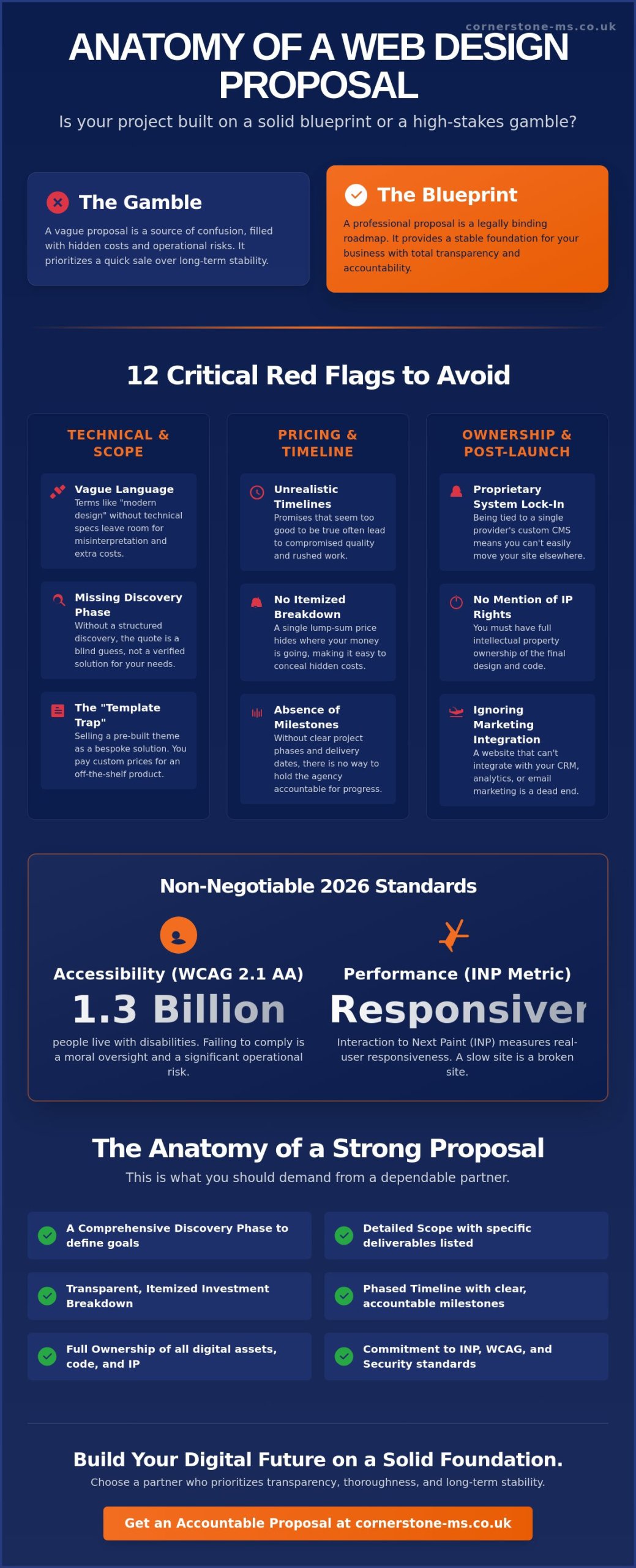
A professional web design proposal is a commitment to accountability, not just a list of features and a price. When you receive a quote, it should feel like a stable foundation for your business rather than a source of confusion. We understand the hesitation that comes with vague technical terms and the fear of hidden costs that often emerge mid-project. Identifying specific red flags in a web design proposal is essential to ensure your site supports your actual business goals instead of becoming a liability. With 1.3 billion people worldwide living with disabilities, failing to address accessibility is no longer just a moral oversight; it is a significant operational risk.
You deserve a partner who values long-term stability over short-term gains. We promise to help you scrutinize every line item so you can avoid being locked into proprietary systems. This article provides a clear framework for vetting agencies and ensuring your site meets the latest 2026 standards, including WCAG 2.1 Level AA compliance and the new Interaction to Next Paint (INP) responsiveness metrics. We will examine the twelve most critical warning signs that separate a disciplined expert from a high-stakes gamble, giving you the confidence to own your digital assets completely and protect your organization’s future.
Key Takeaways
- Understand why a web design proposal is more than a simple quote; it is a legally binding roadmap that dictates the security and success of your digital project.
- Learn to identify vague technical language and the absence of a discovery phase, which are major red flags in a web design proposal that often lead to budget overruns.
- Discover how to spot unrealistic pricing and timelines that compromise quality, ensuring you avoid common market traps that lead to operational instability.
- Protect your digital assets by verifying intellectual property rights and avoiding proprietary systems that can leave your business locked into a single provider.
- Establish a framework for choosing a dependable partner who prioritizes transparency, thoroughness, and the long-term health of your online presence.
What is a Web Design Proposal and What Should it Include?
A web design proposal acts as the structural blueprint for your digital presence. It isn’t just a document you skim before signing; it’s a legally binding roadmap that defines the success or failure of your project. While many businesses confuse a proposal with a simple quote, the difference is significant. A quote provides a price, while a comprehensive proposal explains the strategy behind every decision. This document serves as the essential foundation for your eventual contract, ensuring both parties understand their responsibilities from the outset. Understanding how to identify red flags in a web design proposal before you sign is the best way to protect your investment and ensure your site is built on solid ground.
In 2026, a professional proposal must address more than just aesthetics. It must provide a clear strategy for security, page speed, and mobile responsiveness. Web design is a complex discipline involving technical precision and creative strategy. Specifically, a modern proposal should outline how the agency will meet the Interaction to Next Paint (INP) responsiveness metric and comply with updated accessibility standards like WCAG 2.1 Level AA. If these technical requirements are missing or glossed over, you are looking at one of the first major red flags in a web design proposal. High-quality service is built on thoroughness, not just visual appeal.
The Essential Components of a Professional Document
A reliable proposal leaves no room for ambiguity. It provides a detailed project scope that lists every specific deliverable, from the number of custom templates to the integration of third-party APIs. You should also see a phased timeline. This isn’t just a launch date but a series of milestone dates that hold the agency accountable for progress. Finally, look for a transparent investment breakdown. Professional partners avoid starting from price traps, offering instead a fixed or clearly tiered cost structure that reflects the actual work required. This clarity prevents the hidden costs that often derail smaller projects.
The Purpose of the Proposal Phase
This phase is about more than just numbers. It aligns your business goals with technical execution. We view the proposal as the first step in establishing a unified team approach. It sets the standard for how we will communicate and report progress throughout the project lifecycle. A thorough document ensures you aren’t just buying a website; you’re investing in a solution that supports your operational security and long-term growth. It establishes the rhythm of the partnership, defining how often you’ll receive updates and who your primary points of contact will be. This methodical approach creates a steady sense of security from day one.
Technical Red Flags: Vague Scopes and Missing Discovery
Vague language is often the most significant threat to a project’s financial stability. When a document uses broad terms like “modern design” or “seamless integration” without defining technical parameters, it leaves the door open for unexpected costs. One of the most common red flags in a web design proposal is the absence of a structured Discovery Phase. Without this initial stage, an agency cannot accurately estimate the effort required to meet your specific operational needs. They are essentially providing a blind guess rather than a verified solution. This lack of precision suggests a partner who may prioritize securing a contract over delivering a functional, high-performing asset.
Professional partners follow established guidelines on procuring web development to ensure every technical requirement is documented before a single line of code is written. This includes vetting third-party integrations. If a proposal assumes your current CRM or payment gateway will function perfectly without a technical audit, you are likely to face launch-day failures. Another risk is the “Template Trap,” where an agency sells a pre-built theme as a bespoke solution. While templates have their place for certain budgets, they should be disclosed honestly to avoid paying custom prices for off-the-shelf products that lack scalability.
Why a “Discovery Phase” is Non-Negotiable
We define Discovery as the process of uncovering project risks before they become costs. This phase involves mapping out user personas and customer journeys to ensure the site serves your audience effectively. It also includes a rigorous technical audit of your existing infrastructure to prevent compatibility issues. Skipping this step is a major indicator of a partner who values speed over structural integrity. A disciplined team will always insist on a discovery period to align technical execution with your long-term business goals.
Deliverables: The “What” vs. The “How”
A list of deliverables should never simply state “A Website.” This is a major red flag in a web design proposal because it fails to explain the methodology behind the build. A professional document must detail specific outputs, such as UI/UX wireframes, sitemaps, and sitemap approvals. You should also see a clear commitment to a specific Content Management System (CMS). Knowing exactly how your site will be managed ensures you maintain control over your digital assets. If you want a partner who prioritizes this level of technical precision, you can explore our approach to web design.
Pricing and Timeline Realism: When it Seems Too Good to be True
In the local North East market, we frequently observe a “Race to the Bottom” where agencies drastically reduce prices to win business. This is one of the most common red flags in a web design proposal. While a low price point is attractive, it often signals that the agency hasn’t accounted for the technical rigour required for a high-performing site. Data shows that only 47-54% of websites currently meet all Core Web Vitals thresholds. If a proposal is suspiciously cheap, it likely skips the essential performance optimization and quality assurance (QA) phases that keep your site in that top tier. When agencies skip testing, they often ignore critical accessibility standards. With an estimated 1.3 billion people worldwide living with some form of disability, a site that isn’t tested for WCAG 2.1 Level AA compliance is an operational liability.
A “Fixed Price” can also be a warning sign if it isn’t backed by a granular scope of work. Without a detailed breakdown, a fixed fee is often just a guess. This leads to two unfortunate outcomes: either the agency cuts corners to protect their margins, or they surprise you with additional fees for “extra” work that should have been included from the start. We believe in pricing based on technical reality. A reliable partner will explain exactly how your investment is allocated, ensuring every pound supports your operational security and business growth. A proposal that doesn’t mention a dedicated QA phase is essentially asking you to pay for an unfinished product that may fail under pressure.
Evaluating the Investment Structure
A professional proposal should link payment milestones to specific, verifiable deliverables. We recommend looking for a structure where you pay as work is completed and approved. For example, payments might be tied to the delivery of the initial wireframes or the completion of the development environment. Requesting 100% of the payment upfront for a new partnership is a significant red flag. It removes the agency’s accountability and shifts the entire financial risk to you. You should also ensure the document clearly distinguishes between the one-time project fee and any ongoing retainers for security updates and hosting services.
The Timeline Trap: Speed vs. Quality
Speed is a common selling point, but a bespoke website requires a methodical and purposeful approach. Proposals that promise a two-week turnaround for a complex build are unrealistic and should be viewed with caution. A professional timeline must include dedicated “Client Approval” windows, allowing you time to review and sign off on key stages without being rushed. It must also account for content migration, which is a major time driver in any project. Rushing the process frequently leads to broken responsive web design and poor mobile performance. Remember, a one-second delay in page load time can reduce your conversions by up to 7%.
Post-Launch Red Flags: Ownership and Marketing Integration
Digital independence is the cornerstone of a successful online presence. One of the most restrictive red flags in a web design proposal is the mention of a proprietary Content Management System (CMS). While some agencies claim their custom platforms offer better security, these systems often serve as a “lock-in” trap. If you decide to move your site to a different host or partner in the future, you may find that the code belongs to the agency, not you. This leaves your business vulnerable and forces a complete rebuild if the relationship ends. We believe you should always have full administrative access to your domain, hosting, and source files from day one.
Your website does not exist in a vacuum. It must function as the central hub for all your digital activity. Proposals that ignore the integration of local SEO services are essentially handing you a tool that no one can find. Your site needs to be built with data-driven decision-making at its core, including pre-installed analytics and conversion tracking. This ensures your investment supports your broader social media management Teesside efforts, creating a seamless journey for users coming from various platforms. If a proposal focuses only on aesthetics without mentioning marketing synergy, it isn’t a business solution.
Ownership and Digital Independence
Your digital identity extends beyond the code. A professional document will clarify that you own all creative assets, including your branding agency Newcastle deliverables. A disciplined partner will explicitly state that intellectual property (IP) transfers to your entity upon final payment. Without this clause, you could technically be “renting” your own brand identity. We prioritize this transparency because it builds long-term institutional trust and protects your operational security. If you want to secure your digital future with a partner who values your independence, you can view our full range of services.
Building for Growth, Not Just Aesthetics
Security is an ongoing responsibility, not a one-time setup. A final red flag is the absence of a post-launch maintenance and security plan. Websites require regular updates to protect against vulnerabilities and maintain the performance standards established during the build. A proposal that ends at the launch date suggests a lack of care for the end-user experience and your site’s long-term stability. A reliable partner will outline how they intend to support your site’s health through regular audits and technical updates, ensuring your foundation remains solid as your business grows.
The Cornerstone Standard: Choosing a Dependable North East Partner
We believe that a proposal should be a reflection of an agency’s integrity and technical capability. At Cornerstone Marketing Solutions, we replace ambiguity with technical precision, ensuring that every document we produce serves as a reliable foundation for your operations. While identifying red flags in a web design proposal is the first step toward protecting your business, the second is finding a partner who values long-term stability over short-term gains. We don’t just act as a vendor; we position ourselves as a seasoned, dependable partner. This shift in perspective ensures that your website is treated as essential infrastructure rather than a temporary creative project.
Our approach is rooted in local accountability. Serving businesses across the North East, we understand that our reputation is built on the success and security of the organizations we support. We focus on building long-term institutional trust through a display of competence and methodical planning. We ensure that every operational challenge is identified early, explaining the rigorous processes we apply to reach a verified solution. This creates a steady sense of security that guides you from the initial concept to a high-performing digital asset that actually supports your business goals.
Our Commitment to Technical Precision
We follow rigorous standards and ensure strict regulatory adherence in every project we undertake. Our proposals detail how we achieve seamless integration across all your digital platforms, ensuring your website works in harmony with your broader marketing efforts. We take visible pride in our workmanship and maintain a clear commitment to societal impact, ensuring our technical solutions are both proficient and community-oriented. By prioritizing the end-user experience, we elevate our service from simple provision to a broader mission of improving your digital quality of life.
Next Steps: Evaluating Your Current Quotes
Before you commit to a new partnership, we recommend reviewing your current quotes against the warning signs discussed in this guide. Take the time to ask the tough questions that reveal a provider’s true priorities. If an agency cannot provide a clear answer regarding IP ownership or their specific strategy for meeting the 2026 WCAG 2.1 Level AA accessibility deadlines, you are likely looking at significant red flags in a web design proposal. Use this checklist during your next internal stakeholder meeting:
- Does the proposal include a non-negotiable Discovery Phase?
- Are payment milestones tied to specific, verifiable deliverables?
- Is there an explicit statement regarding your ownership of all digital assets and code?
- Does the timeline include realistic windows for client approval and content migration?
- Is there a defined plan for post-launch maintenance and security?
We invite you to experience a different standard of service. We provide the structural stability and foundational support your business needs to grow with confidence in a demanding digital industry. You can request a transparent, bespoke web design proposal from Cornerstone to see how we prioritize your digital independence and operational success.
Securing the Future of Your Digital Infrastructure
Identifying red flags in a web design proposal is a necessary step to protect your business from operational instability and hidden costs. You now have the framework to demand a thorough discovery phase and ensure full ownership of your code and branding assets. A website built with technical precision, adhering to 2026 standards like WCAG 2.1 Level AA, serves as a reliable foundation for your long-term success. We believe that every technical decision should support your broader business objectives and provide a seamless experience for your end-users.
We invite you to partner with a team that values transparency and methodical planning. Our award-winning Cornerstone Group expertise is grounded in the North East, providing local accountability and comprehensive marketing integration that spans SEO, social media, and professional video. We approach every project with quiet confidence and a commitment to your organization’s growth. Get a transparent, data-driven web design quote for your North East business. Your digital transformation deserves a partner who is as disciplined and dependable as the infrastructure we build for you.
Frequently Asked Questions
What should be included in a web design proposal?
A professional proposal must act as a legally binding roadmap for your project. It should include a detailed scope of work, specific deliverables like wireframes and sitemaps, and a phased timeline with milestone dates. We also ensure that technical standards, such as WCAG 2.1 Level AA accessibility and Core Web Vitals targets, are clearly defined. A document that lacks these specifics is one of the major red flags in a web design proposal to avoid.
How much does a professional business website cost in the UK?
Investment levels vary significantly based on the complexity of your requirements and the level of customization needed. Factors such as the number of unique page templates, the depth of the discovery phase, and the integration of advanced features like e-commerce or third-party APIs influence the final price. We focus on providing a transparent breakdown of costs that reflects the technical rigour and long-term value required for your specific business goals.
Who owns the website once the project is finished?
You should maintain full ownership of your website, including the code, design assets, and content. A reliable partner will explicitly state in the contract that all intellectual property rights transfer to your entity upon final payment. We prioritize your digital independence, ensuring you have complete administrative access to your domain and hosting. Verifying this ownership clause helps you avoid being locked into a restrictive relationship with an agency.
Why is a “Discovery Phase” so important for my project?
The discovery phase is the essential process of uncovering project risks before they become costly mistakes. This stage allows us to map customer journeys, define user personas, and conduct technical audits of your existing systems. By identifying these requirements early, we ensure that the final build is a stable foundation that supports your operational needs. Skipping this phase is one of the most common red flags in a web design proposal.
Can I move my website to a different agency later?
You can move your website if it is built on a portable, open-source platform. We utilize systems that allow for seamless migration, ensuring you aren’t trapped by a proprietary CMS. If an agency uses their own closed software, you may find it impossible to move your site to a different host without a complete rebuild. We believe in building long-term trust through quality service rather than technical lock-in traps.
What is the difference between a bespoke website and a template?
A bespoke website is a custom-engineered solution designed specifically for your brand and user experience goals. In contrast, a template uses a pre-built layout that often includes unnecessary code, which can slow down performance. Bespoke builds offer superior scalability and are optimized for modern responsiveness metrics like Interaction to Next Paint (INP). This methodical approach ensures your site is a high-performing asset that stands out in a crowded market.
How long does it typically take to design and build a website?
Timelines depend on the project’s complexity, but a professional build follows a purposeful, phased progression. This includes dedicated windows for discovery, design approvals, and a rigorous quality assurance phase. While some providers promise “instant” turnarounds, these often lead to broken designs and security vulnerabilities. We prioritize a steady rhythm of work that ensures your digital infrastructure is secure, functional, and ready for a successful launch.